By Roya Saberzadeh, Founder of NiraVira & Rochie’s Inc. — 37 years in business
Let me tell you something that will either make you laugh, cry, or check your own website immediately.
For nearly three years, I poured money, time, and energy into making my e-commerce website better. I hired an agency. I restructured the navigation. I added schema markup so my products would show up as shoppable on Google. I optimized for SEO. I did everything the experts told me to do.
And none of it mattered. Not a single thing.
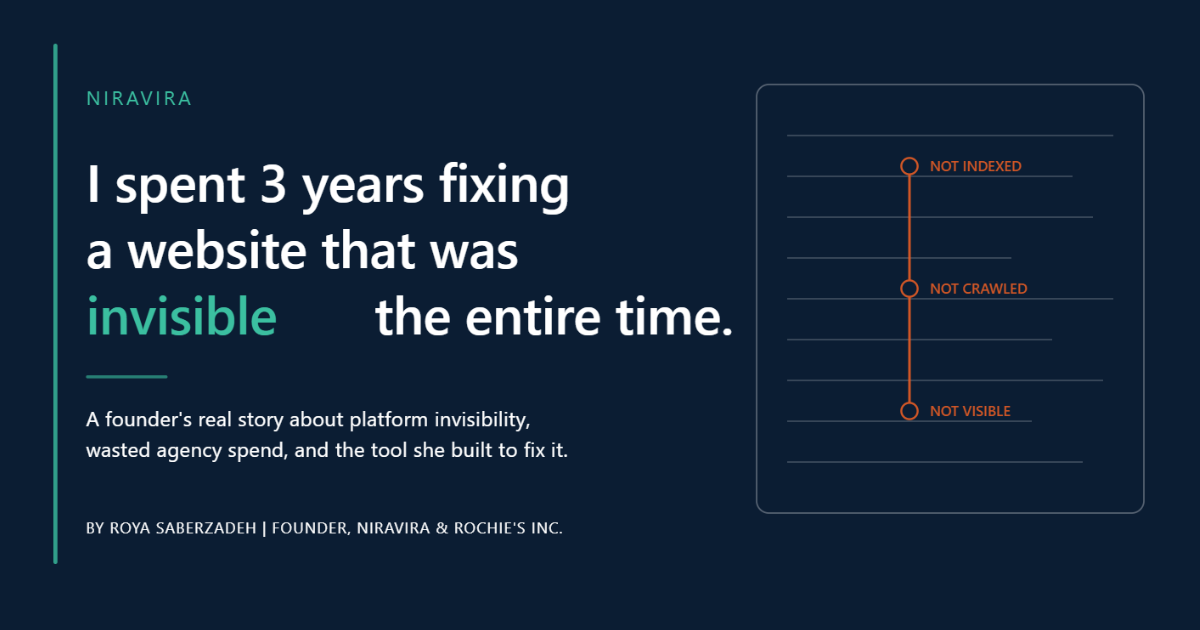
Because my website was built on a platform that search engines couldn’t even read.
Here Is What Happened
I own a custom graduation sash business that has been operating since 1995. We are the original creators of the personalized graduation sash — the kind you see in every commencement ceremony across the country. Our products are handmade in the USA, and we have been serving universities, Greek organizations, and families for decades.
A few years ago, I noticed something was off. Traffic was not growing. Orders were not coming in the way they should for a business with our reputation and history. So I did what any business owner would do — I started investigating.
First, I discovered that the platform I was on had made internal changes that affected how Google indexed my website. Pages that used to show up in search results were disappearing. Product pages were returning blank descriptions to Google. When I would search for my own products, competitors with half our experience and a fraction of our quality were showing up instead.
I thought, OK, I just need to fix the SEO.
So I Hired an Agency
I brought in an agency to restructure everything. They did what agencies do. They updated the site architecture. They improved the navigation. They rewrote meta descriptions. They added schema markup so my products could appear in Google Shopping and Google Merchant Center. They set up proper product feeds.
Good work. Professional work. Work I paid real money for.
But here is the thing nobody told me — and honestly, I do not think they even knew.
The Platform Itself Was the Problem
The website platform I was on uses something called a Single Page Application architecture. In plain language, that means when a person visits the website, they see everything perfectly — the products, the images, the descriptions, the checkout. It looks great. It works great for humans.
But when Google’s crawler visits the same website? It sees an empty shell. A blank page. The content loads dynamically through JavaScript after the page renders, and most search engine crawlers do not wait around for that to happen. They see nothing and they move on.
So every improvement my agency made — every schema tag, every meta description, every carefully written product title — was being applied to a website that search engines were walking right past.
It is like spending thousands of dollars on beautiful interior design for a house with blacked-out windows. The people inside love it. But nobody driving by even knows anyone lives there.
Then Came AI — And It Got Worse
If traditional Google crawlers struggle with these platforms, AI systems are even less forgiving.
ChatGPT, Google AI Overviews, Perplexity, Claude, Copilot — these are the tools people are now using to find products and make buying decisions. And they rely on structured, crawlable data even more than traditional search engines do.
When someone asks ChatGPT “Where can I get a custom graduation sash in California?” — my business, with 30 years of experience and thousands of happy customers, does not even exist in that conversation. Meanwhile, competitors who launched last year on Shopify are getting recommended because their product data is structured and readable.
ChatGPT just launched shopping features. Shopify has native integration. My platform does not. My competitors are now shoppable inside AI conversations. My products are invisible.
That is not a small problem. That is an existential one.
Nobody Was Going to Tell Me This
Here is what really gets me. No agency, no consultant, no platform representative ever sat me down and said, “Roya, the foundation you are building on cannot be seen by the systems that matter.”
They would say things like, “You might want to consider migrating at some point.” But they would not tell me WHY. They would not explain that every dollar I was spending on SEO was being poured into a bucket with no bottom.
I had to figure this out myself. Through months of research, testing, and working with AI tools to audit my own website from every angle.
And when I finally understood the full picture, my mind was absolutely blown.
What I Built Because of It
Once you experience something like this — once you realize you have been operating in the dark for years while thinking you were making progress — you have two choices. You can be angry, or you can make sure it never happens to anyone else.
I chose the second option.
I built a free tool that lets any business owner paste in their website URL and see what is actually happening. Not what their website looks like to humans, but what it looks like to Google, to ChatGPT, to every AI system that is now deciding which businesses get recommended and which ones get ignored.
It checks ten different channels where your business should be visible. It tells you where you are showing up, where you are missing, and what is actually blocking you.
It is completely free. No credit card. No sales call. Just the truth about your website’s visibility.
Because I believe every business owner deserves to know what I did not know for three years.
If This Sounds Familiar, Here Is What I Would Tell You
If you have been investing in your website — doing everything right, following the best practices, maybe even hiring help — and you are still not seeing the results you expected, it might not be your strategy that is broken. It might be your foundation.
Ask yourself:
- Can Google actually crawl and read my product pages, or is it seeing an empty shell?
- When someone asks an AI assistant about my type of business, does my name come up?
- Is my product data structured in a way that AI shopping tools can understand?
- Have I tested what my website looks like to a search engine, not just to a human visitor?
If you do not know the answers, that is exactly what my free audit was built to tell you.
Want to Go Deeper?
The free audit gives you the real picture — where you stand across all ten channels that matter for online visibility in 2026.
If you want to go further, I also offer a detailed report that does not just tell you what is wrong — it tells you exactly how to fix everything yourself, step by step. No agency required. No ongoing subscription. Just clear instructions you can hand to your web developer or follow on your own.
Because after spending years paying other people to fix a problem they did not fully understand, I believe business owners deserve the tools to understand it themselves.
[Run Your Free AI Visibility Audit →]
Roya Saberzadeh is the founder of NiraVira and Rochie’s Inc., a family of brands including Rochie’s Originals (est. 1989) and TheGradStore (est. 1995). She has 37 years of entrepreneurial experience and built NiraVira after discovering that the platforms many small businesses rely on are invisible to the AI systems now shaping how customers find and choose businesses.
Frequently Asked Questions
How do I know if my website has this problem? The fastest way is to right-click on any page of your website, select “View Page Source,” and look at the HTML. If you see very little actual content — mostly script tags and empty divs — your site may be using a single-page application framework that is not crawlable. Or you can simply run our free audit, which checks this automatically.
Which platforms have this problem? Any platform built on a JavaScript single-page application (SPA) framework without server-side rendering can have this issue. Some e-commerce platforms in the decorated apparel industry are known to use this architecture. Platforms like Shopify, WordPress with WooCommerce, and Wix generally render content in ways that search engines can read.
I hired an SEO agency. Shouldn’t they have caught this? Most SEO agencies focus on content, keywords, and backlinks. The architectural rendering problem is a technical issue that requires understanding how JavaScript frameworks interact with search engine crawlers. Many excellent agencies simply are not equipped to diagnose this specific problem. It is not their fault — but it is something business owners need to be aware of.
Is this just about Google, or does it affect AI too? It affects both, and the AI impact is actually more severe. Traditional Google has gotten better at rendering some JavaScript content over the years. But AI systems like ChatGPT, Perplexity, and Google’s AI Overviews rely on structured, immediately readable data. If your website cannot be crawled easily, you are invisible to the fastest-growing discovery channel in the world.
What is the free audit, and what does it check? Our AI Visibility Audit checks your website across ten channels: Google Search, Google Business Profile, Bing and Copilot, YouTube and Video Search, Social Platforms, Review Sites, Off-Site Citations, AI Chatbots, Voice Search readiness, and Schema and Structured Data. You get a clear picture of where you are visible and where you are missing.
How much does the detailed report cost? The free audit gives you the overview. If you want a full diagnostic with step-by-step fix instructions, our detailed reports start at $97. Everything is designed so you can implement the fixes yourself — no agency retainer required.